Alpamayo: When the Biggest Challenge Is Not the Wall but Time

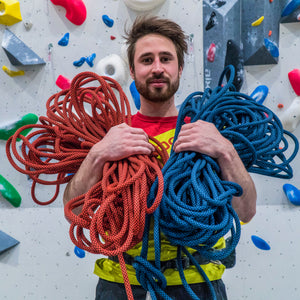
Six Czech Tendon ropes on one of the most beautiful mountains in the world.
Three friends and colleagues, Ivo Novák (Czechia), Kristián Azor (Slovakia) and Lucie Doležalová (Czechia), work in Iceland as glacier guides. But Iceland lacks proper high mountains. And because we always wanted to see South America, this year's adventure took us to Peru. As the main goal of the trip we chose the reputedly most beautiful mountain in the world: Alpamayo in the Cordillera Blanca range.
Three people do not add up very well, though, so Ivo's friend Ajmal Nurrinanuwar (simply Aji) from Malaysia joined us as well.

Acclimatisation
After flying into Huaraz we began, classically, with acclimatisation. The first trip led to the lakes Laguna Churup (4,450 m above sea level) and Laguna Churupita (4,580 m). On our return some of us were not feeling quite well, so we took one more rest day in Huaraz. As a rest-day activity we chose climbing at the Los Olivos climbing area, right in the heart of Huaraz, with a beautiful view of the town and the surrounding mountains. The next stop was the Ishinca valley. We had to change the original plan to climb Tocllaraju, though. Only a few days before our arrival a serac fall there had set off an avalanche that buried two Canadian climbers. May they rest in peace. At that moment there was nothing to think about. The mountains are not going anywhere and no summit is worth unnecessary risk.
Instead we headed for Urus Este (5,420 m). The climb went without complications, and because everything went smoothly, the very next day we added Nevado Ishinca (5,530 m), which we climbed via the north-west face and descended along the south-west ridge.


The hike to base camp (4,300 m) and meeting new climbing partners
After two acclimatisation climbs we felt ready and could finally head for the main goal of the whole expedition. Early in the morning we loaded most of the gear onto donkeys and, with light daypacks, set off on the 24-kilometre hike to base camp. We left as early as possible to avoid the midday heat, because there was hardly a single patch of shade along the way. The kilometres passed surprisingly quickly, though, the valley slowly opened up, and with every kilometre more peaks of the Cordillera Blanca appeared before us.
About halfway we gained another member of the expedition. A local mountain mutt, Alík, decided to come with us and accompanied us all the way to base camp. When we had pitched the tents, rain came and we all crawled into our tents to hide. After a while, however, we heard Czech from outside. At first we thought we had misheard, but really: right next to us Míša and Jirka were pitching a tent. They had the same plan as we did, but we did not yet suspect that we would spend so much time together, both in endless waiting beneath the wall of Alpamayo and in sharing joy.

Even the shortest day can be the hardest: with a heavy backpack to the high camp (5,450 m)
The next day brought a short but really demanding move. Barely three kilometres did not look at all threatening on the map, but with almost seven hundred metres of ascent, heavy backpacks and all the climbing gear on our backs they turned into an honest three hours of toil. When we finally dropped the packs from our backs, it was an incredible relief. In the afternoon the sky clouded over and it began to snow and rain, so we spent the rest of the day bundled up in the tents, chatting or playing cards.
The following day we moved to the high camp, which is entirely on the glacier, and that lightened our packs by quite a lot of gear that we put on straight away. It was supposed to be a fairly quick job, 3.7 km and 494 m of elevation gain, but it was not. Right after stepping onto the glacier we began meeting one group after another, which did not matter much in the first part because we were only walking on the glacier. The second half was more complicated, with four pitches of climbing, and here the groups began to bunch up and queues for climbing were already expected. On the steeper part of the glacier, interwoven with seracs and crevasses, several groups were suddenly moving at the same time. Nobody waited for the previous team to finish the whole section, so ropes crossed and tangled and sometimes, instead of climbing, we were deciding whether to step over a stranger's rope or crawl under it. A move that was supposed to take a few hours dragged out to six and a half hours because of constant waiting. When we finally reached the high camp, the sun was already setting. We pitched the tents in a hurry and only then stopped for a moment. Before us Alpamayo finally appeared in all its glory.


A surprise: "The moment we counted 22 tents in the high camp, it was clear to us that the climbing itself might not be the biggest problem."
When we counted 22 tents in the high camp, we were quite horrified. Even before we left we knew that recently many teams had been turning back not because of bad conditions but precisely because of long waiting beneath the wall. And now we saw that a similar problem might await us too.
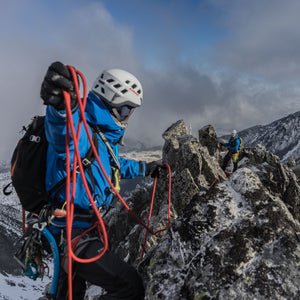
Two routes are commonly climbed on Alpamayo: French Direct and Basque-French. French Direct, the more frequently climbed variant, had dangerous conditions at the time of our ascent because of a large chunk of ice hanging in the middle of the face that looked as if it could break off at any moment. Everyone therefore headed for the only safer remaining option, Basque-French. It has its disadvantages compared with French Direct. The first comes right at the start, in crossing the bergschrund. Twenty metres of ice climbing of difficulty WI 4, where, because of the number of people, some of whom do not have sufficient experience for climbing of this difficulty, a queue naturally forms. The second disadvantage waits at the end. The climb does not finish directly on the summit, and after hours of climbing on the face a short but very exposed ridge still awaits us, which is safe to cross only early in the morning while the snow is hard.

A three-and-a-half-hour wait in the queue. Are they giving out bananas for free?
After a sleepless night we set off shortly after midnight. Normally people start around one o'clock, but we wanted to get a head start and reach the climbing section among the first groups. The way to the bergschrund took us just under an hour, and from afar we noticed that we were only the fourth group in line. The first two groups were already at the start of the wall, so we thought that by the time we reached them they would have the beginning behind them and we could start straight away.
Wrong.
When we arrived beneath the wall, only the first climber had gone up so far. There were seven more people ahead of us. Many climbers who were going with guides obviously did not have sufficient ice-climbing experience, so they fell and struggled, and climbing 20 metres up could easily take one climber half an hour. On top of that, big chunks of ice kept falling from the wall, so it was impossible for several climbers to climb at the same time.
The wait thus stretched to almost four hours. We stood in the dark and cold and watched our time slowly slip away. Gradually it dawned on us that we were actually the last group of the day. The irony was that if we had set out three hours later, we would have arrived at exactly the same time, only we would have avoided freezing beneath the wall and would have slept a bit more.

A race against time
At last we climbed onto the ice wall. The first pitch was quite a grind, but nothing we could not handle. When we reached the first belay, dawn began to break. With the growing light the character of the climbing changed too: the angle eased to about 70 degrees and pure ice was replaced by a combination of snow and ice.
Seven more pitches awaited us, and above all a race against time. To speed up our progress we took turns leading and left the screws in the ice straight away for the second pair as well. Even so, everything went more slowly than we needed.
The rising temperature during the day was not the only danger. The groups above us kept dropping chunks of ice that could not be fully avoided. Several times chunks of ice hit our helmets, hands or shoulders. At one point a shout even rang out: "Snow anchor!" Someone from the upper groups had dropped one. Fortunately only Ivo took it, with a harmless hit on the hand and a torn glove.

Risk and pride, or safety and respect?
We reached the end of the last climbing pitch around 12:30, together with Míša and Jirka. About another 50 metres of exposed ridge awaited us to the summit. But it was already late and the hard morning snow had meanwhile softened.
Jirka tried to continue, but halfway along the ridge it turned out that conditions were not ideal. It was not possible to build safe protection and a possible fall would have been too great a risk not only for Jirka but for the others too. In the end he therefore turned back. It was not worth the risk.
So we had to be satisfied with our "almost summit". Even so, we declare Alpamayo (5,947 m) conquered: our highest point reached, at roughly 5,940 m. Four Czechs, one Slovak, one Malaysian and six Czech Tendon ropes.

Descent and a look back
Before the descent we shot a few clips with a drone that Ivo had hauled all the way to the summit. Thanks, Ivo! Eight rappels awaited us. Everything went smoothly and without unnecessary complications, exactly as you wish at such a moment. The Tendon ropes worked brilliantly and we could rely on them from the first pitch to the last rappel.
The way back to the high camp seemed endless, but slowly and surely they trudged back. At sunset, 17.5 hours after the start, we returned to the tents. The original plan to descend all the way to base camp the same day did not work out in the end, because we had neither the strength nor the light left. After a demanding day we slept like babies.
In the morning we packed the still-frosty tents and, again together with Jirka and Míša, rappelled down. At base camp we repacked our backpacks, the heavy ones went onto donkeys, and we, with light daypacks, walked another 24 kilometres back to civilisation. When we showed photos to the locals in Huaraz and told them how many people had been at base camp, they shook their heads in disbelief. We had probably hit some of the busiest days on the mountain.
Despite the tiring waiting, the cold and the long day, it was worth it. Alpamayo showed us not only the beauty of the mountains but also how important it is to be able to decide at the right time. And next time? Next time we will definitely choose a less popular mountain.

Jiří Pavelka and Michal Veselý with TENDON Master PRO 7.6
Lucie Doležalová and Kristián Azor with TENDON Alpine 7.9
Ivo Novák and Ajmal Nurrinanuwar with TENDON Master 8.6
Text: Lucie Doležalová
Photos: Ivo Novák @ivonovak_photography


More stories

Todra: where the history of Moroccan climbing began
The first country on our honeymoon trip through Africa was Morocco. And our first climbing stop was the Tod...
Číst příběh →
Tendon Young Mountaineers 2026: record-breaking final at Čížkovy kameny
On Saturday 19 September 2026 the final of the ninth Tendon Young Mountaineers competition took place at Čí...
Číst příběh →
Boreal multi-pitch, or a slightly different day in Iceland
Vestrahorn: a glacier, a black sand beach, mountains, the ocean and a Viking village in one view. The Stok...
Číst příběh →